
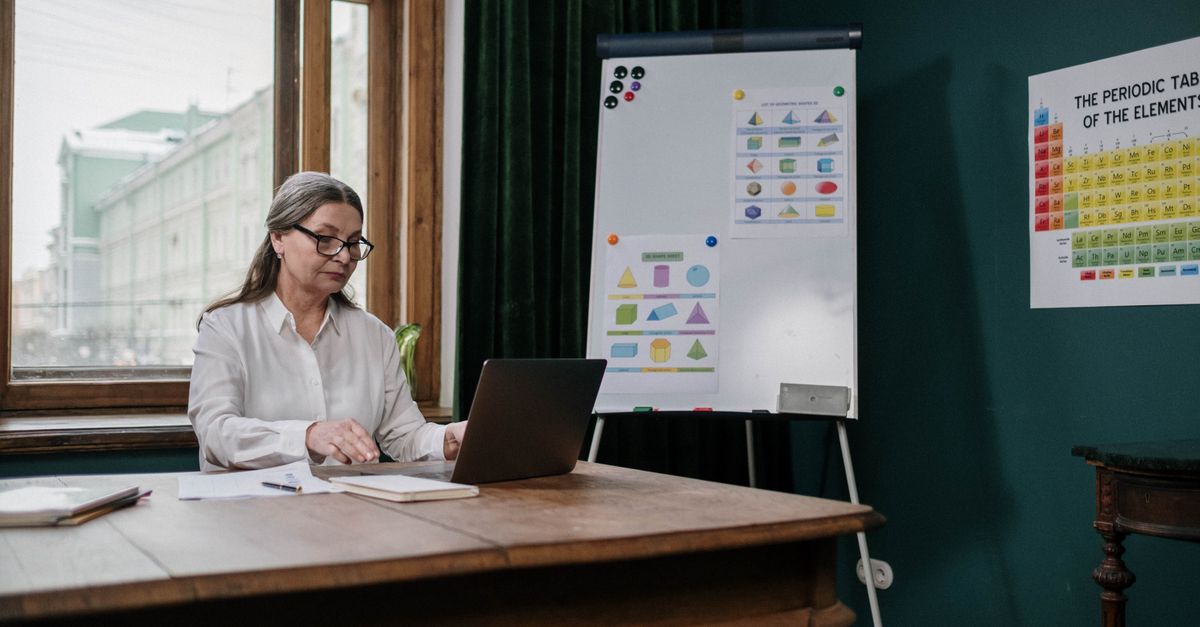
Al Rabanera starts every semester the same way. He tells his math students at La Vista High School in Fullerton, California, that he already knows they’re using AI. “I’m not going to pretend like you aren’t,” he says. Then he shows them what he’s built because of it.
Rabanera’s classroom looks different now than it did three years ago. Gone are the rote problem sets students could lift wholesale into a chatbot and paste back. In their place: a unit on buying a car that threads interest rates, monthly payments, and credit scores through a real purchase decision. Poster projects. In-class design challenges. Word problems students invent themselves around things they actually care about. He didn’t make these changes because he wanted to. He made them because the old homework model stopped working.
He’s far from alone.
What the Research Actually Shows
The intuition that students are offloading work to AI has now been confirmed at scale. A study led by Sina Rismanchian at the University of California, Irvine analyzed 3.2 million student math problems on the ALEKS digital learning platform across a decade. After ChatGPT launched in late 2022, high school students spent 31% less time on word problems compared to graph-based problems that required hands-on interaction with the platform. College students showed a 27% decline on the same comparison. When those same students were tested under proctored conditions with no AI access, the copy-paste behavior disappeared entirely.
The damage wasn’t just to academic integrity. The odds of students correctly answering AI-susceptible word problems fell by 25% in the post-ChatGPT period. Students who outsourced their practice didn’t just submit work that wasn’t theirs. They skipped the cognitive struggle that makes the learning permanent.
That word, struggle, matters here. There’s a body of research on what’s sometimes called “desirable difficulty,” the idea that mild cognitive strain during practice, confusion, retrieval effort, working through something without being handed the answer, is precisely what encodes knowledge into long-term memory. When a student types a word problem into ChatGPT, gets a worked solution, and pastes it into their assignment, they have bypassed every part of that process. The correct answer appears on their paper. Nothing is retained.
The College Board reported that by May 2025, 84% of high school students said they use AI tools for schoolwork, up from 79% just four months earlier. That number will keep climbing. The question for educators is what to do with the reality it describes.
The Assignment Design Problem
John Singleton, an economics professor at the University of Rochester and co-author of the ALEKS study, put it plainly: assigning short writing tasks to college students is, in his words, “insane these days.” You receive 25 AI-generated essays back. No comprehension has been gauged. No thinking has been forced. The assignment did nothing.
This is the structural problem teachers are now confronting. Traditional homework, short written responses, problem sets, reading questions, worked examples, was built on the assumption that effort correlated with output. A student who produced a solid paragraph probably thought through the material. That assumption is gone.
What’s emerging in its place is a set of design principles that experienced teachers like Rabanera are already applying, often by necessity. The assignment has to either require real-time presence, demand personalization that AI can’t generate, or produce something a student has to explain and defend.
Presentations and oral exams are getting renewed attention for exactly this reason. A student can submit an AI-written essay, but they have to speak from their own understanding in a five-minute conversation with their teacher. In-class work, where AI access is limited by circumstance or policy, recovers the link between effort and product. Assignments tied to a student’s specific context, their school, their neighborhood, their own creative decisions, generate responses that AI tools struggle to produce convincingly.
Justin Reich, who directs MIT’s Teaching Systems Lab and hosts a podcast focused on this exact problem, noted that while researchers are racing to build Socratic tutoring systems and guided AI learning environments, many students are simply using the technology to bypass the work entirely. The intent of the technology and its actual use in homes and bedrooms are two different things.
What Educators Should Know
The productive framing for teachers right now is not whether to allow or ban AI. Schools are navigating that question differently, and no single policy fits every context. The more actionable question is: which of my current assignments are AI-proof, and which are assignment-shaped exercises in copy-paste?
A few honest assessments most teachers can run on their own homework designs:
Can a student complete this without ever thinking? If a student can feed the prompt directly to a chatbot and submit the output without reading it, the assignment has a design problem. That doesn’t mean it was a bad assignment before 2022. It means the context changed.
Does the assignment require something the student knows about themselves? Rabanera’s word-problem inversion, where students generate the problems, works because it requires the student to make creative decisions. An AI can write a math word problem, but only the student knows what they would choose to write one about. Assignments that require self-reflection, local knowledge, or personal stance are harder to outsource.
Would you know if this was AI-generated? This isn’t about detection tools, which have shown unreliable accuracy and have flagged non-native English speakers disproportionately. It’s about whether you have a baseline for the student’s voice, thinking, and ability. Teachers who hold brief one-on-one check-ins or ask students to annotate their own work before turning it in are building a practice record that makes anomalies obvious.
What’s the learning target, and does this assignment actually reach it? If the goal is conceptual understanding in math, a problem set may be the wrong tool entirely right now. If the goal is argument construction in writing, a five-paragraph essay submitted outside of class may not be reaching it anymore. This is a good time to ask whether the assignment was designed to produce the learning or just to generate a grade.
The Harder Conversation
There’s something worth sitting with here. AI was genuinely supposed to help students learn, and for some students it does. When a student uses an AI tutor to re-explain a concept they missed in class, work through a problem step by step, or get feedback on a draft before submitting, they’re using the technology in exactly the way its developers intended. The research on AI tutoring in math, in particular, has shown real promise for students with gaps in foundational knowledge.
The problem is that the same tool that can scaffold a struggling learner can also produce a completed assignment in 12 seconds. Students under time pressure, facing too much work, or simply uninterested in a topic will take the path of least resistance. That’s not a character failure. It’s a design problem.
Singleton said something worth quoting directly: the findings “certainly require a rethinking of what the object of homework is.” He’s right. Homework was designed to extend practice and reinforce classroom learning. If the practice isn’t happening, the homework is producing grades without producing learning, and that’s a problem regardless of which student is submitting it.
Teachers like Rabanera who have already redesigned their practice are doing something harder and more valuable than policing AI use. They’re building assignments worth doing. That’s always been the goal. The current moment is just making it more urgent.
EdTech Institute covers technology in education so teachers can focus on what matters: their students.
EdTech Institute also builds free, classroom-ready tools for teachers at RazaEd.
Source: The End of Homework? Teachers Grapple With Cheating in the Age of AI (The 74)